Ask ten people at a dinner table whether they're vegetarian and you'll get ten different answers, each meaning something slightly different. One person avoids red meat but eats chicken. Another won't touch eggs. A third won't consume anything that involved harming an insect. These aren't contradictions, they're different dietary frameworks entirely, and confusing them in a restaurant setting can cause real distress for diners who depend on accurate classification.
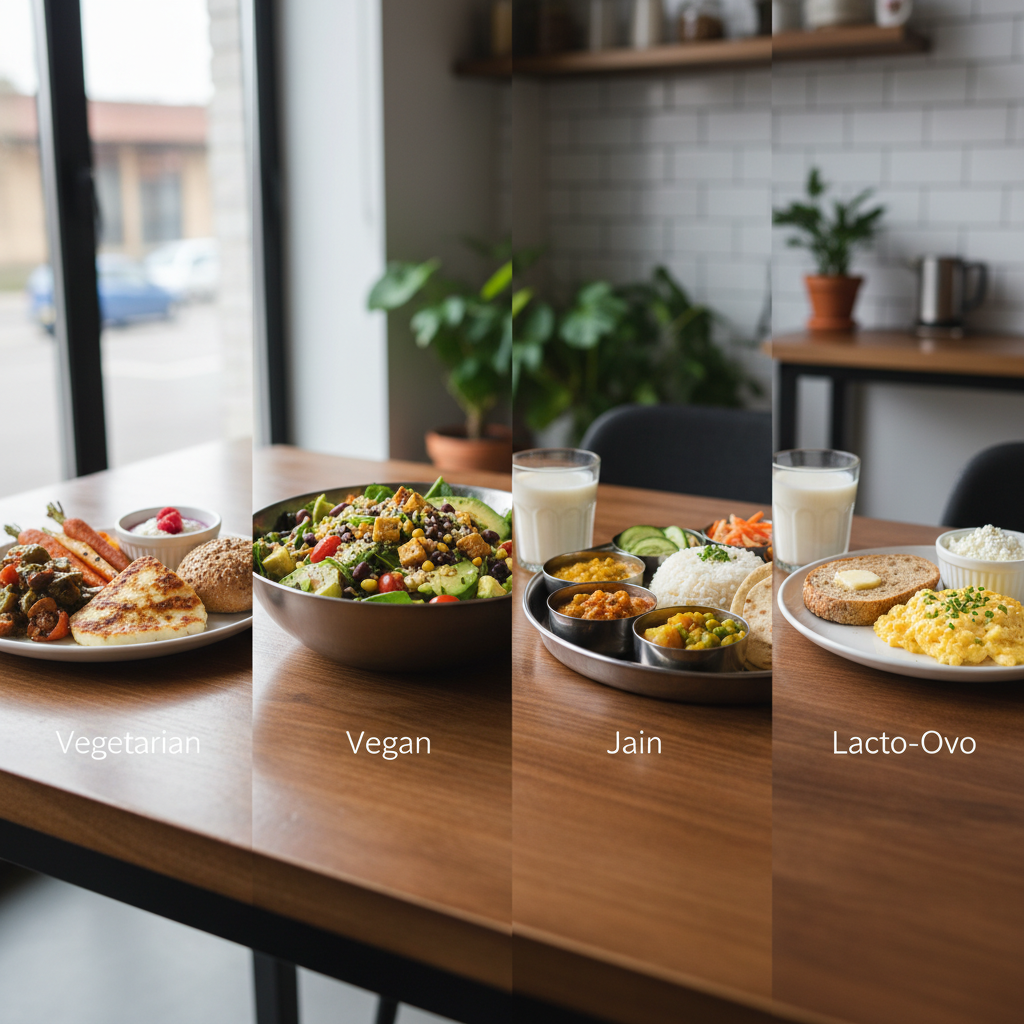
This guide breaks down the key distinctions between four commonly misunderstood categories: standard vegetarianism, veganism, Jain vegetarianism, and the lacto-ovo diet. Whether you're navigating a menu abroad, cooking for guests, or simply trying to understand what a label on a restaurant menu actually means, getting these definitions right matters more than most people realize.
What Does "Vegetarian" Actually Mean?
The word "vegetarian" is one of the most misused terms in food culture. In its broadest, most commonly accepted definition, a vegetarian diet excludes all animal flesh. That means no beef, pork, poultry, or seafood. What it doesn't automatically exclude depends heavily on which branch of vegetarianism someone follows.
The International Vegetarian Union defines vegetarianism as the practice of abstaining from meat, poultry, and fish, but this definition still leaves significant room for variation around dairy, eggs, and other animal-derived products. That flexibility is precisely where the confusion begins.
The Main Vegetarian Sub-Categories
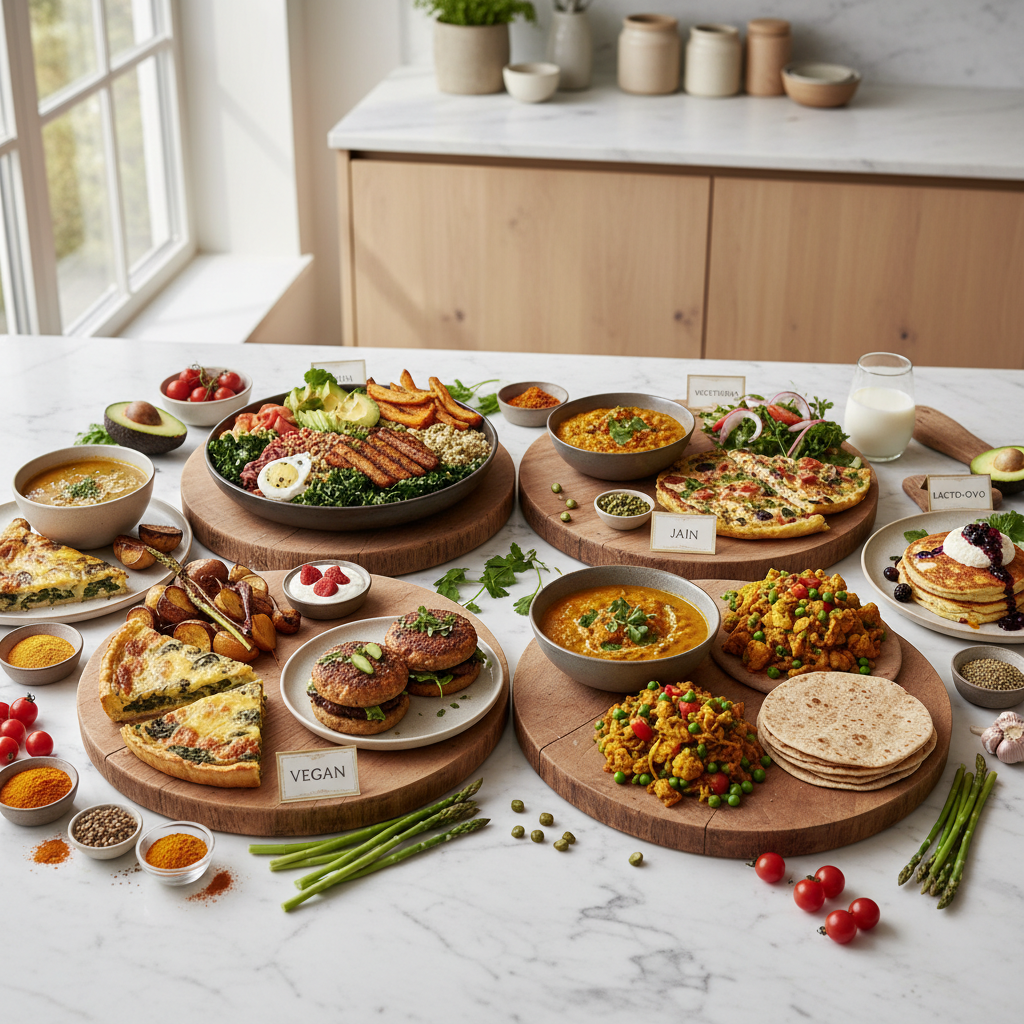
Understanding the full spectrum helps clarify what someone actually eats when they identify as vegetarian:
- Lacto-vegetarian: Consumes dairy products but not eggs
- Ovo-vegetarian: Consumes eggs but not dairy
- Lacto-ovo vegetarian: Consumes both dairy and eggs
- Vegan: Excludes all animal-derived products, including dairy, eggs, and honey
- Jain vegetarian: Follows strict plant-based eating with additional restrictions rooted in non-violence
When someone says they're "vegetarian" without further specification, they most commonly mean lacto-ovo vegetarian in Western contexts. But this assumption doesn't hold universally, particularly across South Asian, East Asian, or religiously observant communities.
Vegan vs. Vegetarian: Where the Line Really Falls
The distinction between vegan and vegetarian is more than a matter of degree. Veganism is a philosophy as much as a diet. Most vegans avoid not just animal-derived foods but also animal-tested products, leather, wool, and any industry that exploits animals. On the dietary side, this means eliminating everything that vegetarians might still consume, including eggs, dairy, honey, gelatin, and food colorings derived from insects (like cochineal, listed as E120).
For restaurant dining, the practical differences are significant. A vegetarian-labeled dish might contain butter, cream, or egg-based sauces. For a vegan diner, none of those options are acceptable. Learning to read menus through this lens, and knowing which questions to ask, is where many diners run into trouble.
Hidden Animal Products to Watch For
Some ingredients catch even experienced vegans off guard:
- Casein and whey: Milk proteins found in many processed foods, including some breads and protein powders
- L-cysteine: An amino acid often derived from poultry feathers, used in commercial baking
- Isinglass: A fish-derived fining agent used in some wines and beers
- Carmine (E120): A red pigment extracted from scale insects, used in some juices and desserts
For anyone with serious dietary convictions or medical needs, these details aren't minor. They're the difference between a meal that aligns with your values and one that doesn't. Tools like AlignEat exist precisely for this reason, scanning menus instantly to flag these hidden ingredients before you order.
The Lacto-Ovo Vegetarian Diet: the Most Common Framework
The lacto-ovo vegetarian diet is statistically the most widely followed form of vegetarianism around the world. It excludes all animal flesh but permits both dairy products and eggs. This makes it the most accessible version for many people because protein sources like yogurt, paneer, and eggs are available in virtually every cuisine.
In practical terms, a lacto-ovo vegetarian dining at an Italian restaurant can eat pasta with cheese sauce. They can order a South Indian thali with ghee and curd. They can request a mushroom omelette at a French café. The flexibility is real, which is part of why this category dominates in global dining contexts.
Lacto vs. Ovo: a Meaningful Distinction
The split between lacto-vegetarian and ovo-vegetarian diets is often glossed over, but it has significant implications at the table. Many practicing Hindus follow a lacto-vegetarian diet, consuming dairy (which holds cultural and religious significance in Hinduism) while strictly avoiding eggs, which are considered non-vegetarian in many Indian traditions. An ovo-vegetarian, by contrast, skips dairy but eats eggs, sometimes due to lactose intolerance or a preference for avoiding the dairy industry's practices.
Neither is more "correct" than the other. But conflating them in a restaurant kitchen or on a menu can create real problems for diners with firm restrictions.
Jain Vegetarianism: the Most Restrictive Framework
Of all the dietary systems covered here, Jain vegetarianism is the most detailed and, for those unfamiliar with it, the most surprising. Rooted in the Jain principle of ahimsa (non-violence toward all living beings), the Jain diet goes well beyond avoiding meat. It prohibits any food that involves killing or harming any living organism, including microscopic ones.
What Jain Vegetarianism Excludes
The exclusions in Jain dietary rules extend far beyond what most people expect from a plant-based framework:
- Root vegetables: Potatoes, onions, garlic, carrots, beets, and radishes are all avoided because harvesting them kills the entire plant and potentially the organisms living in the soil
- Eggplant and certain multi-seeded fruits: Avoided by some Jain practitioners
- Honey: Not consumed because collecting it harms bees
- Alcohol and fermented foods: Often avoided due to the presence of microorganisms
- Eating after sunset: A traditional practice to avoid accidentally consuming insects attracted to light
This means a restaurant dish labeled "vegan" or even "vegetarian" can still be completely unsuitable for a Jain diner if it contains onion or garlic, two of the most common base ingredients in global cooking. For Jain diners eating out internationally, this creates a genuine challenge that standard menu labels simply don't address.
A Counterargument Worth Acknowledging
Some critics of highly restrictive dietary frameworks argue that they can lead to nutritional gaps, particularly around B vitamins, iron, and calcium. For Jain practitioners who also avoid root vegetables, getting adequate iron and certain micronutrients requires careful planning. This isn't a reason to dismiss the framework, but it's an honest reminder that any restrictive diet benefits from nutritional awareness. Understanding what's in your food at an ingredient level becomes even more important when your dietary boundaries are complex.
Side-by-Side Comparison: What Each Diet Allows
Seeing these four frameworks laid out together makes the differences immediately clear.
Food Category | Lacto-Ovo Vegetarian | Vegan | Jain Vegetarian | Lacto-Vegetarian |
|---|---|---|---|---|
Meat, poultry, seafood | No | No | No | No |
Dairy | Yes | No | Yes (typically) | Yes |
Eggs | Yes | No | No | No |
Honey | Often yes | No | No | Often yes |
Root vegetables (onion, garlic, potato) | Yes | Yes | No | Yes |
Alcohol | Often yes | Depends on fining agents | No | Often yes |
Insect-derived colorings (e.g., carmine) | Often yes | No | No | Often yes |
This table is a starting point, not a complete rulebook. Individual practitioners vary in their interpretations, and cultural context shapes how these categories are applied in real life. According to food allergy research, a significant proportion of people with dietary restrictions also have medically diagnosed allergies layered on top, which adds another dimension of complexity when eating out.
Why These Distinctions Matter in a Restaurant Setting
Restaurant menus rarely go beyond labeling something "V" for vegetarian or "VG" for vegan. That's a starting point, but it doesn't tell you whether the vegetarian pasta was cooked in shared pots with meat, whether the "vegan" dessert contains carmine, or whether the curry base includes onion and garlic. For someone following a Jain diet or managing severe food allergies on top of a vegan lifestyle, those gaps in information are genuinely stressful.
This is exactly why having a reliable tool to decode menus before you order changes the experience entirely. Rather than relying on server knowledge (which varies enormously) or guessing from ingredient lists written in a foreign language, you can get clear answers quickly.
Where These Diets Are Heading
Dietary classifications are becoming more sophisticated, not simpler. As global awareness of food ethics, sustainability, and health grows, we're seeing a rise in hybrid frameworks: people who follow a Jain diet on weekdays but eat eggs on weekends, or vegans who make exceptions for locally sourced honey. Restaurants in cities like London, Singapore, Mumbai, and São Paulo are increasingly building menus that cater to these nuanced needs rather than treating "vegetarian" as a single checkbox.
From a technology standpoint, the future looks promising. AI-powered menu analysis is already capable of identifying not just standard dietary labels but specific ingredients that conflict with individual dietary frameworks. As these tools become more sophisticated, they'll be able to cross-reference menu items against Jain dietary law, specific allergy profiles, and macronutrient targets simultaneously. What's currently a manual, stressful process for many diners will become effortless.
We also expect clearer international standardization around food labeling, particularly as the global movement of people with diverse dietary needs demands more transparency from restaurants. A Jain traveler dining in Tokyo or a vegan navigating a traditional French brasserie shouldn't have to rely on luck or linguistic fluency to eat safely.
Conclusion
The terms vegetarian, vegan, Jain, and lacto-ovo aren't interchangeable, and treating them as synonyms creates real problems for people whose dietary needs are non-negotiable. A lacto-ovo vegetarian and a Jain vegetarian share the "vegetarian" label but eat very different things. A vegan and a Jain follower both avoid animal products but for different reasons and with different rules about what counts.
Getting these distinctions right is the foundation of confident, stress-free dining, whether you're the one with the restriction, the person cooking for someone, or a server explaining a menu. The more clearly we all understand what these labels actually mean, the better the dining experience becomes for everyone at the table. That's the kind of clarity we're working toward at AlignEat, one menu at a time.
Frequently Asked Questions
Is a lacto-ovo vegetarian the same as a regular vegetarian?
In most everyday contexts, yes. When someone describes themselves as vegetarian without any qualifier, they usually mean they follow a lacto-ovo vegetarian diet, eating no meat, poultry, or fish but including both dairy and eggs. However, this isn't universal. In many South Asian cultures, "vegetarian" often means lacto-vegetarian (dairy yes, eggs no), so it's always worth clarifying what someone means rather than assuming.
Can a Jain vegetarian eat at a vegan restaurant?
Not automatically. While vegan menus exclude all animal products, they typically include root vegetables like onions, garlic, and potatoes, which are prohibited in Jain dietary practice. A dish can be 100% vegan and still completely unsuitable for a Jain diner. Jain travelers and diners often need to review menus at a more granular ingredient level than standard dietary labels provide.
What's the difference between an ovo-vegetarian and a vegan who eats eggs?
An ovo-vegetarian intentionally includes eggs in their diet while excluding all other animal products, including dairy. A vegan, by definition, does not eat eggs. Someone who identifies as vegan but occasionally eats eggs would technically be ovo-vegetarian rather than vegan, since veganism excludes all animal-derived foods. Labels matter here, especially when you're communicating your needs to a kitchen or using a menu tool to filter safe options.
Sources referenced: International Vegetarian Union dietary definitions; Food Allergy Research and Education (FARE) statistics on food restrictions; Healthline ingredient guides for food additives and animal-derived components.